
You need enough trained staff to carry out your building’s evacuation arrangements whenever they may be needed. The right number depends on your evacuation chairs, the people who may need assistance, the layout of your premises and the staff available at different times.
Having trained employees on your records is not the same as having suitable cover on every shift. If the people you rely on are on holiday, off sick or working elsewhere, your evacuation plan still needs to work.
Here, we look at how to plan Evacuation Chair Training around the way your workplace actually operates.
Is There a Fixed Number of Staff Who Must Be Trained?
There is no single headcount that is suitable for every workplace.
For premises covered by the Regulatory Reform (Fire Safety) Order 2005, the Responsible Person must nominate a sufficient number of competent people to implement the evacuation procedures. The Order defines competence in terms of sufficient training and experience or knowledge, together with other qualities needed to carry out those procedures properly.
For evacuation chair arrangements, this means looking beyond the number of people who have attended a course. Your fire risk assessment and evacuation plan should inform how many trained people you need, where they need to be and how you will maintain cover.


Start With the Chair and Your Evacuation Arrangements
Check the manufacturer’s instructions for the particular chair you use. Different models and situations can involve different operator requirements. Do not assume that every chair is designed for the same number of operators.
The number needed to operate one chair is also different from the total number of staff you may need to train.
When reviewing your arrangements, consider:
- The number and type of evacuation chairs provided.
- The people who may need assistance and their individual requirements.
- The floors, staircases and evacuation routes involved.
- Whether assistance may be needed in more than one location.
- The staff available to carry out the agreed procedures.
An evacuation chair is not automatically the right aid for every person or situation. Government guidance on means of escape for disabled people explains the importance of planning around individual needs and involving the person concerned.
Your chair arrangements should fit within your Fire Emergency Evacuation Plan (FEEP) and any relevant Personal Emergency Evacuation Plans (PEEPs), rather than being treated as a separate equipment issue.
Plan Cover for Every Shift, Not Just the Busiest One
Check when your trained staff are actually on site. A list of course attendees may look reassuring, but it can hide gaps in the rota.
Review cover for:
- Early starts, late finishes and shift handovers.
- Night shifts and weekends, where these apply.
- Annual leave and unexpected sickness.
- Breaks, off-site duties and hybrid working.
- Staff leaving or moving into different roles.
Also check whether the same person has been allocated other emergency duties that would prevent them from providing the planned assistance.
A useful starting point is to compare your evacuation arrangements with a typical rota and then consider what happens when a trained member of staff is unexpectedly absent. If this leaves a gap, review the arrangements and training provision before relying on that cover.
Who Should Receive Evacuation Chair Training?
Training should be provided to the people who are expected to operate the chair as part of your evacuation arrangements.
Depending on your organisation, these may include fire wardens, facilities staff, reception teams, care staff or other designated employees. The decision should reflect the duties they will carry out, not simply their job title.
Do not assume that being a fire warden automatically means someone is competent to use an evacuation chair. Check that they have received appropriate practical training for the equipment and arrangements they are expected to use.
Not every employee necessarily needs to become a chair operator, but staff should understand their own responsibilities within the wider evacuation plan.

Keep Your Training Cover Up to Date
Review your arrangements when staff, equipment or the way the building is used changes. Training records are useful, but they should support a working plan rather than replace one.
Keep a clear record of who has been trained, when the training took place and which equipment it covered. Compare this with current staffing arrangements so that gaps can be identified and addressed.
If you need help bringing your arrangements together, Benfield Fire Safety provides support with Fire Emergency Evacuation Plans and fire safety policies.
Frequently Asked Questions
Not necessarily. Even if the chair and your evacuation arrangements require two operators, training only two people may leave you without cover when one is absent. Assess the equipment requirements, assistance needs and staffing patterns together.
Yes. If your evacuation arrangements rely on a chair during occupied night shifts, your staffing and training plan needs to cover those shifts, not just daytime operations.
Check what their previous training covered, whether it remains current and whether it relates to the chair used at your premises. They also need to understand your building’s evacuation arrangements. Previous attendance alone should not be treated as confirmation that they are ready for the role.
Related Articles
- Evacuation chair refresher training: when should staff be retrained?
- Evacuation chair training and PEEPs
Arrange Practical Evacuation Chair Training for Your Team
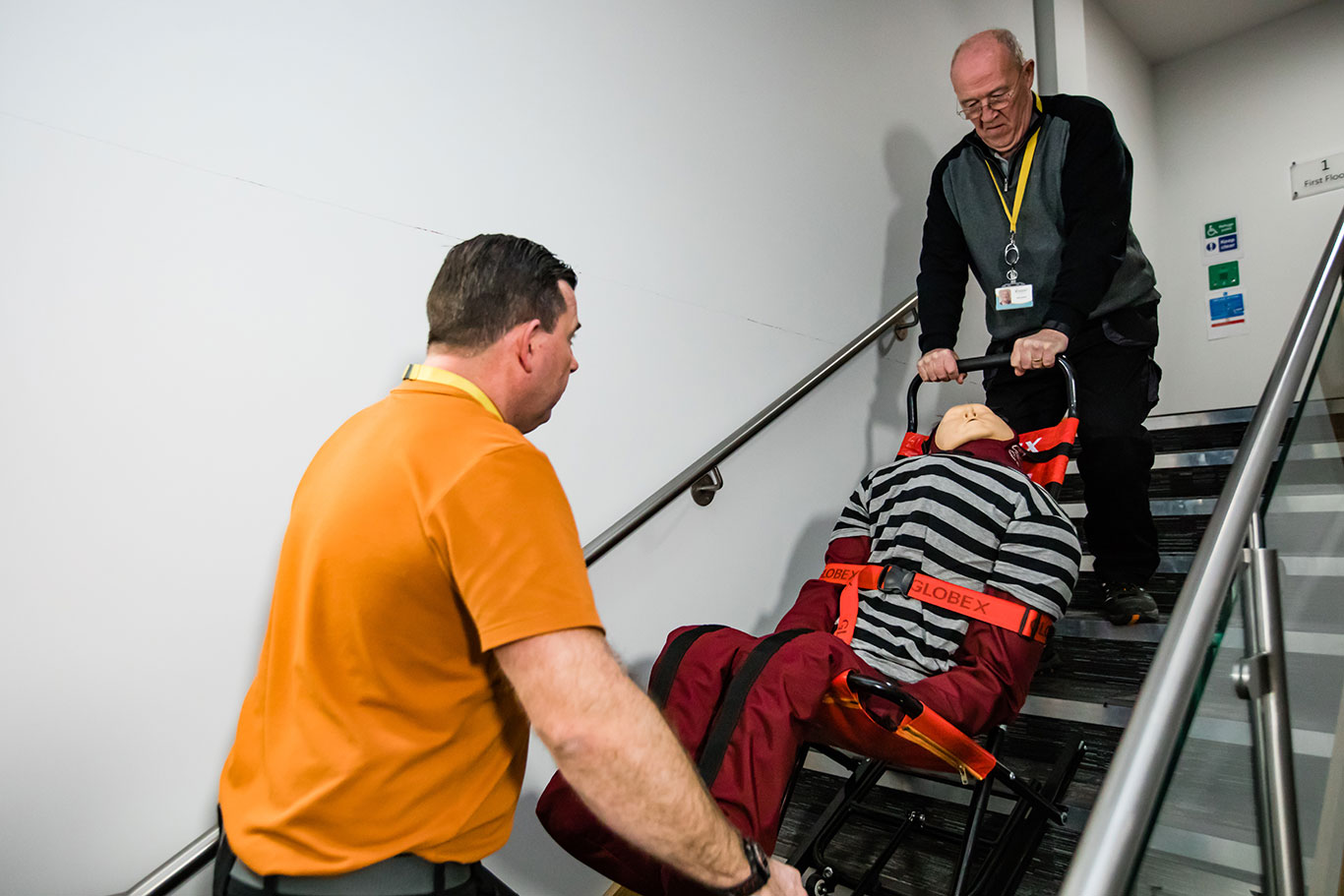
Benfield Fire Safety delivers on-site Evacuation Chair Training, combining theory with practical instruction. Staff train using the chair provided at your premises and a designated staircase, helping them become familiar with the equipment and environment in which they may need to use it.
Our courses accommodate a maximum of eight candidates, and consecutive courses can be run on the same day where more staff need training. This is a course group limit, not a recommended number of trained staff for every workplace.
To discuss Evacuation Chair Training for your team in Eastleigh, Hampshire or our wider service areas, contact Benfield Fire Safety for bespoke pricing and course arrangements.
Call: 0300 303 3277

