
Evacuation chairs are rarely used in day-to-day operations. That is a good thing, but it also means the skills staff learn on a course may not be practised again for a long time.
Employers often ask how long evacuation chair training lasts and when staff need to be retrained. Benfield Fire Safety treats competency as valid for two years, with consideration given to skill fade. However, a set interval is only part of the picture. Changes to your equipment, premises or staff responsibilities may mean further training is needed sooner.
Here, we look at when evacuation chair refresher training may be needed, what can prompt Evacuation Chair Training to be refreshed and how to keep your arrangements working in practice.
What Does the Law Say About Refresher Training?
For premises covered by the Regulatory Reform (Fire Safety) Order 2005, the Responsible Person must ensure that employees receive adequate safety training. This includes training when they start work and when they are exposed to new or increased risks, such as a change in their responsibilities, the introduction of new equipment or a change to the systems of work in use.
The Order also requires training to be repeated periodically where appropriate and adapted to take account of new or changed risks.
The Order does not set a single retraining date for evacuation chair operators. Your fire risk assessment, evacuation plan and the manufacturer’s instructions for your chair should all inform your approach.
What Is Skill Fade?
Skill fade is the gradual loss of knowledge, confidence and practical ability when a skill is not used regularly.
Operating an evacuation chair involves more than knowing where it is stored. Staff need to remember how to set the chair up, transfer and secure the passenger, control the chair on the stairs and work safely with any other operators. These are practical skills, and they can become less familiar over time.
In a real emergency, staff may also be working under pressure, in an unfamiliar situation and alongside the noise and disruption of an evacuation. Hesitation or incorrect handling at that point can put both the operator and the passenger at risk.
This is why our two-year competency period is given with consideration of skill fade, rather than as a guarantee that every operator will remain confident until the end of it.


When Might Staff Need Retraining Sooner?
Review whether further training is needed when something changes that affects how the chair would be used. This may include:
- A new or different model of evacuation chair being introduced.
- Changes to staircases, escape routes or the layout of the building.
- Moving to new premises or using the chair on a different staircase.
- A member of staff taking on chair duties as part of a new role.
- Changes to your Fire Emergency Evacuation Plan or relevant Personal Emergency Evacuation Plans.
- New individual assistance needs, including people who may need a transfer into the chair.
- A drill, review or incident showing that staff lacked confidence or did not follow the agreed procedure.
- A long period since an operator last practised with the chair.
If any of these apply, it may not be sensible to wait for the next planned refresher date.
Changes in Equipment
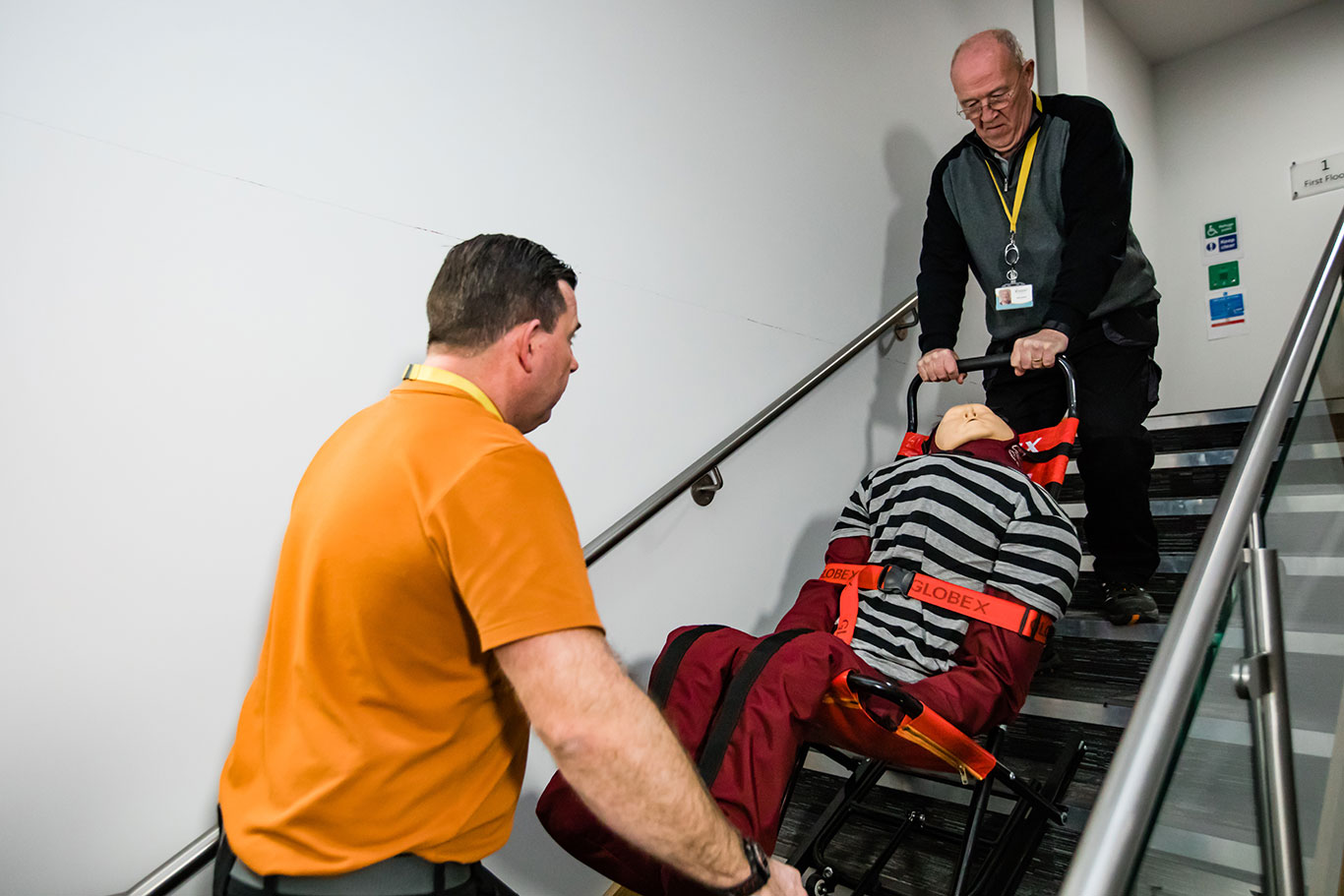
Evacuation chairs are available in different forms, including models designed to descend stairs and climber chairs that can be used to ascend stairs. Controls, straps, braking arrangements and handling methods can vary between models.
Staff who are confident with one chair should not automatically be assumed to be competent with another. When new equipment is introduced, check the manufacturer’s instructions and consider whether operators need training on that particular model.
Changes in Premises
Staircase width, landings, turns, handrails and the space available at the top and bottom of the stairs can all affect how a chair is handled.
This is one reason why Benfield Fire Safety delivers evacuation chair training on-site, using a designated staircase within your building. If your premises change, or the chair would now need to be used on a different route, review whether your staff are familiar with the new conditions.

Changes in Staff Responsibilities
Training records should reflect the people who are actually expected to use the chair today.
Staff turnover, new shift patterns and changes in job roles can all leave gaps in your arrangements. A member of staff who was trained some time ago but has not been expected to operate the chair since may need refresher training before they are relied on again.
Equally, someone newly given chair duties should receive appropriate training before the arrangements depend on them.
Keeping Skills Fresh Between Courses
Refresher training is important, but it is not the only way to support confidence. Depending on your premises and arrangements, you may wish to:
- Make sure operators know where the chair is stored and can access it quickly.
- Include the chair arrangements when you review your evacuation plan.
- Check that the chair is maintained in line with the manufacturer’s instructions.
- Keep clear records of who has been trained, when and on which equipment.
- Ask operators whether they feel confident in their role.
Any practice with the chair should be carried out safely and in line with the training staff have received and the manufacturer’s instructions.
Frequently Asked Questions
Benfield Fire Safety treats competency as valid for two years, with consideration given to skill fade. Further training may be needed sooner if your equipment, premises or staff responsibilities change.
Check the manufacturer’s instructions and compare the new chair with the one staff were trained on. If the model, controls or operating method are different, operators may need training on the new equipment.
Not without checking. Consider when they were trained, what equipment the training covered, whether they have practised since and whether your premises or evacuation arrangements have changed.
Related Articles
Arrange Evacuation Chair Refresher Training
Benfield Fire Safety delivers practical, on-site Evacuation Chair Training, combining theory with practical instruction. Staff train on the specific chair used within your premises and on a designated staircase, so they can refresh their skills in the environment where they may need to use them.
Courses take approximately two hours and accommodate a maximum of eight candidates. Consecutive courses can be run on the same day where more staff need training.
To discuss refresher or new-starter Evacuation Chair Training for your team, contact Benfield Fire Safety for bespoke pricing and course arrangements.
Call: 0300 303 3277

