
If you are responsible for fire safety in a commercial building, you may be wondering how often fire doors need to be inspected and whether there is a single inspection interval that applies to every workplace.
For many small non-domestic premises, government guidance recommends that fire doors are checked at least every six months to make sure they remain in good condition, are free from damage and continue to fit properly within their frames. However, this should not be treated as a universal rule for every building. The appropriate frequency depends on the premises, how heavily the doors are used, their condition and the findings of the fire risk assessment.
Doors exposed to heavy traffic, repeated impact or frequent use may need checking considerably more often.
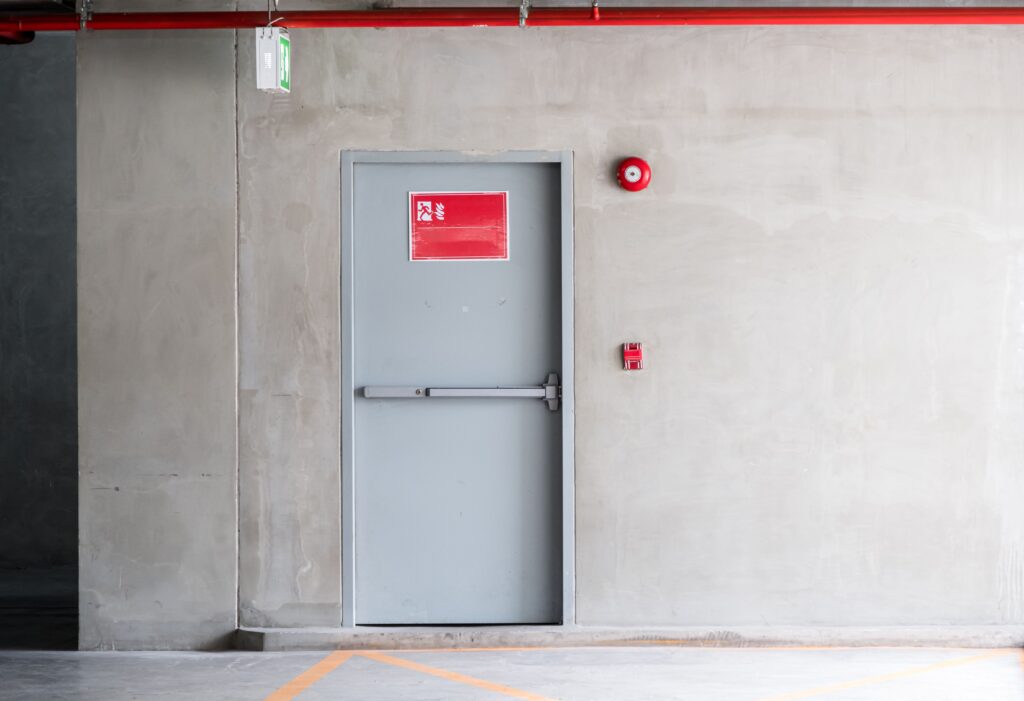
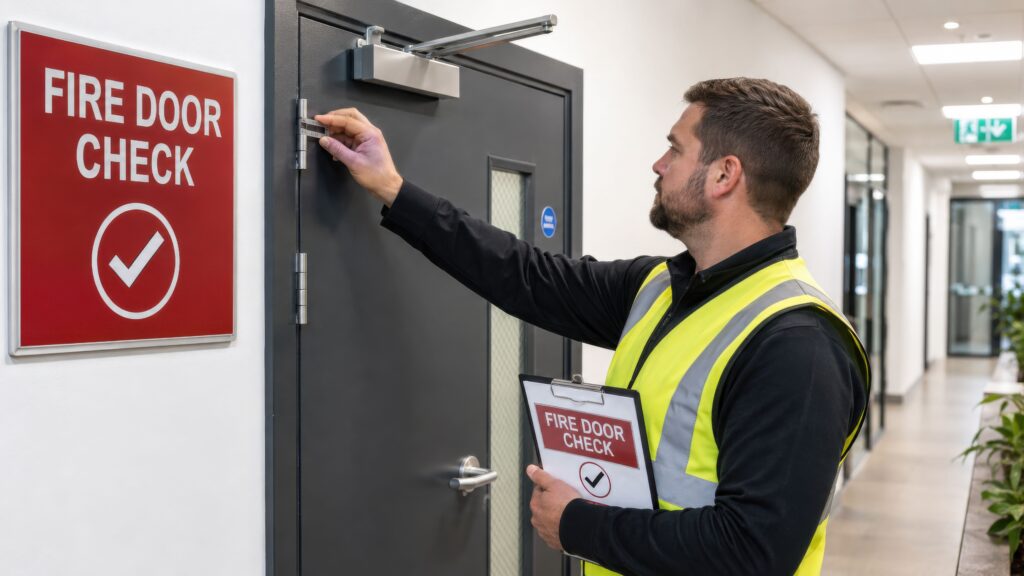
The Short Answer: How Often Should Commercial Fire Doors Be Checked?
A useful starting point for many commercial premises is:
- Carry out regular visual fire door checks as part of routine building management.
- Arrange a more detailed inspection at least every six months where this is appropriate for the premises.
- Increase the frequency where doors receive heavy use or are more likely to become damaged.
- Inspect a door sooner if you notice damage, poor closing, alterations or another reason to doubt its condition.
- Follow any specific frequency identified by your fire risk assessment or competent fire safety professional.
The key point is that inspection frequency should reflect risk and condition, rather than simply relying on an anniversary date.
Government guidance for small non-domestic premises includes six-monthly checks of fire doors, while also making clear that fire precautions should be informed by a suitable and sufficient fire risk assessment.
Why Fire Door Inspection Frequency Matters
Fire doors are designed to help restrict the spread of fire and smoke through a building. For them to perform as intended, the complete door assembly needs to remain in suitable condition.
Unlike some passive fire protection measures, fire doors are regularly opened, closed, pushed, pulled and occasionally damaged during normal use. In busy workplaces, they may be used hundreds of times over a relatively short period.
A door that appeared satisfactory several months ago could later develop problems such as:
- damage to the door leaf or frame
- loose or damaged hinges
- damaged seals
- problems with the self-closing device
- excessive or uneven gaps
- obstructions preventing full closure
- damaged glazing or associated components
Regular fire door checks help identify these issues before they are allowed to persist.
Is Every Six Months a Legal Requirement for Commercial Premises?
Not in the sense of there being one statutory six-month rule that applies identically to every commercial fire door in every type of building.
Under workplace fire safety requirements, the Responsible Person must put appropriate fire safety measures in place and maintain them. They must also carry out and regularly review a fire risk assessment.
Government guidance for small non-domestic premises recommends six-monthly fire door checks, but the correct inspection regime should still reflect the individual building and its risks.
This distinction is important.
A low-use door in a relatively quiet office may not experience the same wear as a cross-corridor fire door in a busy school, warehouse or large workplace. Applying exactly the same checking routine without considering how the building is actually used can miss the point of effective fire safety management.
When Should Fire Doors Be Inspected More Frequently?
Some doors warrant closer attention because their condition is more likely to change between scheduled inspections.
Fire doors on busy corridors, stairways and circulation routes can experience significantly more wear.
Repeated opening and closing can affect hinges, closers, latches and alignment. Doors can also be struck by trolleys, equipment or other objects in busy working environments.
Where a door receives heavy use, more frequent checks may therefore be appropriate.
Commercial and industrial environments can present particular practical challenges.
Doors may be exposed to:
- moving stock
- pallets and equipment
- forklifts or trolleys nearby
- frequent staff movement
- changing layouts
- accidental impact
A fire door inspection programme should take the way the building operates into account rather than relying only on a fixed calendar interval.
Do not automatically wait until the next scheduled inspection if work has been carried out on or around a fire door.
Changes to ironmongery, glazing, closers, frames or surrounding construction can affect how the door performs.
If there is any doubt following building work, maintenance or refurbishment, the door should be checked.
A scheduled inspection date should never become a reason to ignore an obvious defect.
If a fire door stops closing properly, becomes damaged or appears to have developed a fault, it should be investigated rather than left until the next routine inspection.
What Should Routine Fire Door Checks Look For?
Routine checks do not always need to involve a detailed technical examination.
The purpose is to notice signs that a door may no longer be operating as intended.
Government fire door guidance identifies several useful areas to look at, including the condition of the door and frame, seals, gaps and whether self-closing devices are working correctly.
Typical points include:
- Does the door close fully into its frame?
- Does the self-closing device operate properly?
- Is there visible damage to the door or frame?
- Are seals present and undamaged where required?
- Do the hinges and other fittings appear secure?
- Is the glazing undamaged?
- Are there unusual or excessive gaps?
- Is anything preventing the door from closing?
- Has the door been altered since it was last assessed?
These routine observations can help identify obvious problems, but they are not necessarily a substitute for a more detailed fire door inspection where one is required.

Fire Door Checks and Professional Inspections Are Not the Same Thing
It is useful to separate everyday monitoring from a detailed inspection.
Routine fire door checks may be carried out by someone within the organisation who has received appropriate instruction and understands what obvious faults to look for.
A more detailed inspection requires greater knowledge of fire door assemblies, their components, condition and relevant requirements.
Government guidance makes a similar distinction in the residential context, explaining that straightforward routine checks are not intended to replace more detailed assessment by fire safety specialists where that level of assessment is needed.
For commercial premises, the same practical principle is useful: staff can keep an eye on doors between inspections, but this should not lead an organisation to assume that a brief visual check answers every technical question about the condition of the door.
Benfield Fire Safety provides professional fire door inspections for organisations that need a more detailed assessment of their fire doors.
What Can Make a Fire Door Fail an Inspection?
It is not always one dramatic defect.
In practice, problems can develop gradually through normal building use.
Common concerns can include:
- a door that does not close fully
- damage to the door leaf or frame
- missing or damaged seals
- unsuitable gaps around the door
- loose or damaged hinges
- faults with the closer
- damage to glazing
- alterations that may affect the door assembly
- inappropriate wedges or objects holding the door open
One small defect may appear insignificant when viewed in isolation, but a fire door works as an assembly. The leaf, frame, seals, ironmongery, glazing and closing mechanism all have a role.
That is why checking only whether a door “looks like a fire door” is not enough.
Who Is Responsible for Making Sure Fire Doors Are Checked?
In commercial and other non-domestic premises, responsibility normally sits with the person or people who have legal responsibility for fire safety.
Government guidance explains that this can include:
- employers
- owners
- landlords
- occupiers
- facilities managers
- building managers
- managing agents
- others with control of the premises
These individuals may be considered the Responsible Person, depending on the circumstances. Where more than one Responsible Person exists, they must work together to meet their responsibilities.
The practical task of carrying out checks can be delegated, but responsibility for making sure suitable fire safety arrangements are in place cannot simply be ignored.
Should Fire Door Inspections Be Recorded?
Keeping records is good practice and can make ongoing management significantly easier.
A useful fire door record may include:
- the door location or identification number
- inspection date
- condition observed
- faults identified
- photographs where appropriate
- remedial action required
- date remedial work was completed
- name of the person carrying out the inspection or check
A consistent record makes it easier to identify recurring defects and track whether recommended work has been completed.
It can also help organisations manage larger numbers of doors across offices, schools, warehouses and other commercial sites.
Benfield Fire Safety can provide its fire door inspection reports in PDF format or through a live online portal, depending on the client’s requirements.
Do Newer Fire Doors Still Need Regular Checks?
Yes.
A recently installed fire door can still become damaged or develop an operational problem.
Installation quality is important, but so is what happens afterwards. A door may be affected by daily use, accidental impact, adjustments, building movement or later maintenance.
Regular inspection is therefore about maintaining the condition and performance of the door throughout its working life, not simply checking older doors.
Do Older Fire Doors Automatically Need Replacing?
Not necessarily.
Age alone does not automatically mean that a fire door has to be replaced.
Government guidance notes that a fire door does not need replacement simply because it does not meet the latest standard if it remains in full working order from a fire safety perspective.
However, older doors can require careful assessment because identifying their original specification and components may be more difficult.
If there are questions about an older door’s condition or suitability, professional assessment can help determine the appropriate next step.
What About Fire Door Inspection Rules in Residential Buildings?
Commercial premises should not be confused with certain multi-occupied residential buildings, where specific inspection frequencies apply under the Fire Safety (England) Regulations 2022.
For multi-occupied residential buildings in England above 11 metres, Responsible Persons must:
- check communal fire doors at least every three months
- use best endeavours to check flat entrance fire doors at least every 12 months
Those specific intervals relate to the buildings covered by those regulations and should not simply be copied across to every commercial workplace.
For a business premises, the inspection regime should be based on the applicable fire safety duties, the fire risk assessment, the condition of the doors and how the building is used.
A Practical Fire Door Inspection Schedule for Businesses
For many businesses, a sensible approach is to combine regular internal monitoring with scheduled professional assessment.
For example:
Ongoing: Staff and building managers remain alert to obvious problems such as damaged doors, faulty closers or doors being wedged open.
Routine checks: Appropriate visual checks are carried out at a frequency suited to the building and use of the doors.
Periodic inspection: A more detailed inspection is scheduled in line with the fire risk assessment and relevant guidance. For many small non-domestic premises, six months provides a useful benchmark.
After an incident or alteration: Additional checks are arranged following damage, refurbishment, repair or any significant change that could affect the fire door.
This approach is generally more useful than viewing fire door inspection as a once-a-year administrative task.
Frequently Asked Questions
There is no single inspection interval that applies to every office. Government guidance for small non-domestic premises recommends six-monthly fire door checks, but the appropriate frequency should also reflect the fire risk assessment, door condition and level of use. Busy doors may need checking more frequently.
Staff may be able to carry out straightforward visual checks if they have appropriate instruction and understand what to look for. More detailed technical inspections should be carried out by someone with the necessary competence for the task.
Yes, where building work, refurbishment or maintenance may have affected the door, frame, closer, glazing or surrounding construction. There is little benefit in waiting for the next planned inspection if the door’s condition may have changed.
Do not ignore it until the next inspection. A fire door that fails to close correctly should be reported and assessed so the cause can be identified and appropriate remedial action taken.
No. A fire door inspection focuses specifically on the condition and performance of fire doors and their associated components. A fire risk assessment considers the wider fire risks and precautions within the premises.
When Is It Time to Arrange a Fire Door Inspection?
If you cannot confirm when your commercial fire doors were last inspected, have noticed visible defects, have recently altered the premises or manage doors that receive heavy daily use, it may be sensible to review your current inspection arrangements.
Benfield Fire Safety is based in Chandler’s Ford, Eastleigh and supports organisations across Hampshire with professional fire safety services. Our experienced fire safety professionals include former Fire Officers with more than 30 years of practical Fire and Rescue Service experience.
You can learn more about Benfield Fire Safety’s Fire Door Inspection service or discuss your premises and inspection requirements with the team.
Call: 0300 303 3277

